GitLevel crestGitLevel

Not what you've done.
Who you're becoming.

GitLevel reads your GitHub history and forges it into an RPG character card — your language becomes a class, your craft becomes levels, your journey earns a rarity. A guild registry for your growth as a developer.

Forge your card Explore the classes

0 cards forged

UNIQUE A GitLevel character card

The turning point

Stat cards count your work. None of them tell you who you are.

The old question

“What have you done?”

A tally. Commits, stars, streaks — a spreadsheet with a logo.

commits 4,102 · stars 3,410 · PRs 288 · streak 37

The GitLevel question

“Who are you becoming?”

An identity. A class earned by your craft, a title that evolves, a rarity that means something.

Lv 31 · Rust Eternal Guardian · Legendary ★★★★☆

The calling

Every language is a class.

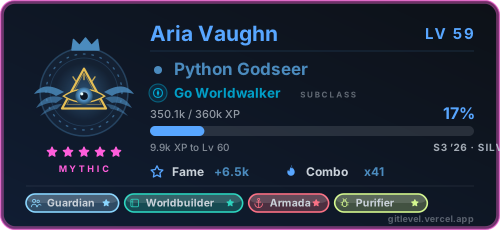
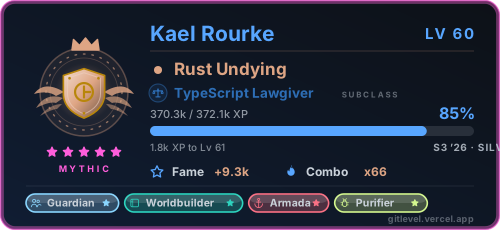
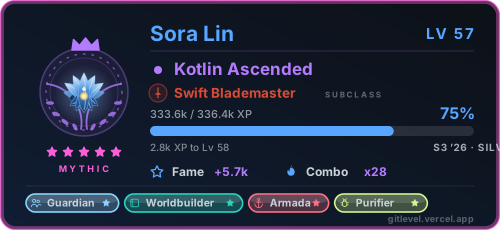
Your most-used language sets your profession; your second becomes a subclass, and earns a crest of its own. A glyph, a colour, a lineage of titles — all your own.

Python class card — the Godseer line
PYTHON · THE GODSEER
Rust class card — the Undying line
RUST · THE UNDYING
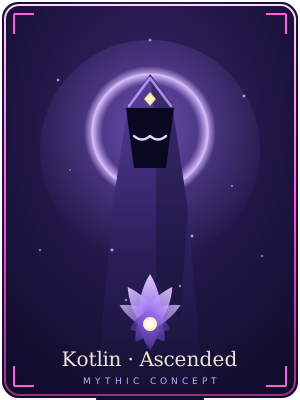
Kotlin class card — the Ascended line
KOTLIN · THE ASCENDED

31 languages carry bespoke class ladders — from Python & Rust to Assembly, Ada, Julia, COBOL & Erlang — and every other language still gets classed.

The ascent

Craft is the only currency.

XP comes from what you build — commits, PRs, reviews, issues, repos — amplified by your years on GitHub. Popularity is a separate axis. No shortcuts to prestige.

★
Common
Lv 1–5
★
Rare
Lv 6–14
★
Epic
Lv 15–28
★
Legendary
Lv 29–54
★
Mythic
Lv 55+ · the few

A quiet, high-level artisan and a famous newcomer read as genuinely different characters — because fame lives on its own axis, apart from XP.

Choose your calling

Every class has a path.

All 31 classes carry their own five-tier ascent. Pick one to trace its titles — and meet its crest.

Class crest

Rust

The quarter

Your level is a career.
Your rank is right now.

Levels are quadratic and honest, which means a veteran's card barely moves. So there's a second axis running underneath it: every calendar quarter is a season, and season XP counts only what you shipped inside it. One line on your card. It resets in January, April, July and October.

Iron0
Bronze1,500
Silver5,000
Gold12,000
Mythril30,000

Nothing decays. Ever.

A quiet quarter shows a low rank — and touches nothing else. Your level, class, tier and badges are untouched by seasons, and no rank you've earned is ever taken back. Decay is how a tool that's meant to flatter you starts making you resent it.

No multipliers.

Tenure, combo and fame exist to make a career legible. A season is just “what did you make in these 90 days”, so it reads exactly the same for someone in their first month and someone in their fifteenth year.

Finished seasons go on the shelf.

Your character sheet keeps every quarter you've played. A season's mark can only be earned while that season is running — there is no way to go back and collect one later.

S1 ’26Silver
S2 ’26Bronze
S3 ’26Gold
S4 ’26Silver

Your card links to your character sheet — where the XP came from, your full class ladder, every badge's next rung, and the shelf.
The next chapter

The art keeps ascending.

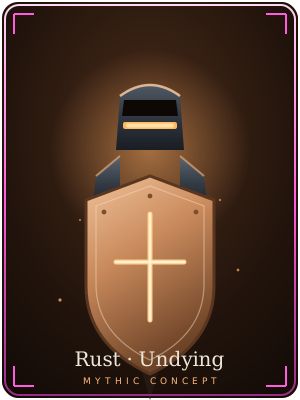
Every class already carries its own painted emblem. The next step is full character art — atmospheric, rarity-graded portraits that make a Mythic card feel genuinely earned. Where that's heading:

Concept art — Python Godseer
Concept art — Rust Undying
Concept art — Kotlin Ascended

Begin your ascent

Forge your card.

Enter your GitHub username. No sign-up, no token, no setup — just your handle.

Your GitLevel card preview

Paste that into your profile README. Cards are cached, so repeat views stay fast.

Raise your own banner

Run GitLevel yourself.

Every card here is served from a deployment holding one GitHub token. Spin up your own in about two minutes — Vercel clones the repo and asks for a single token. Then your README (and anyone else's) can point at your URL.